• Skip to content
  • Skip to primary sidebar

Unconventional Wisdom - The Tuvel Communications Blog

Engaging Your Customers in Unconventional Ways

Header Right

  • About
  • Services
    • Attendee Marketing
    • Speaker Acquisition
    • Influencer Marketing
    • Advocacy Campaigns
    • Social Media Outreach
  • Case Studies
  • Contact Us

Kari Rippetoe

Social Media Mythbusters: 5 Myths About Social Media ROI

June 30, 2011 by Kari Rippetoe

I’ve been reading a higher-than-usual number of blog posts and articles about social media ROI – how to measure it, what to measure, what not to measure. I’m not sure if there was some sort of collective epiphany that led to this all of a sudden (or I just have ROI on the brain), but many of these posts have given me some food for thought about the topic – so I decided to write my own post.

As you read through the many articles floating around out there, here are some of the myths I’ve discovered about social media ROI to help give you a little bit of perspective:

  1. ROI can’t be measured for social media marketing. Sorry, but marketers can no longer fall back on this excuse. When social media first started gaining momentum as a potentially viable marketing channel, no one was quite sure yet about how to measure efforts. Because it was a very young medium, there was a gap in terms of knowledge and tools to help us do this. Now that social media has really come into its own as a marketing channel, our collective  knowledge about it has grown and more tools have become available to track a variety of metrics, including ROI.
  2. The only return that matters in social media is Return on Engagement (ROE). I remember a couple of years ago when “Return on Engagement” was being touted as the “new ROI” for social media. I like to say that social media is all about being social, and “engagement” is one of those buzz words we as marketers throw around to describe how social our organization, brand, etc. is.  While engagement in social media is important, it simply cannot be substituted for ROI. It doesn’t matter how many friends, fans or followers you’ve accumulated, or even how many retweets or wall posts you get. If you can’t track all your hard work back to some sort of conversion – whether that’s a purchase, a sign-up, a donation, or whatever conversion goal you’ve determined – then all of that won’t amount to squat.
  3. Social media ROI is calculated the same way as for any other marketing campaign. I recently read a post on Mashable about how to calculate the ROI of social media, and while it provided a good foundation, it took a basic ROI formula used for more traditional marketing channels and applied it to social media. Using direct mail as an example for comparison, the post would have you believe that you would need to acquire X amount of customers in X amount of time via social media to demonstrate ROI. What it didn’t take into consideration was the time social media actually takes compared to other channels, and that social media is not direct response. What you have to do is take what you know about calculating ROI for your other marketing efforts and apply that in a way that works for your specific social marketing initiatives, knowing that social media is not a quick hit. It requires more direct customer engagement (there’s that buzzword again) and less direct response marketing. Here’s a post that provides an interesting social media take on the traditional ROI formula.
  4. Social media isn’t worth getting into if direct ROI can’t be measured. ROI can be determined in a variety of ways – it just depends on, as I mentioned in #2, what your conversion goals are. You might not be able to track monetary ROI, but you can track other conversions that are just as valuable. Plus, social media can help you uncover a wealth of insights about your customers, your product, your brand, and your organization that can be just as valuable. If you’re able to identify a potential flaw with your product or negative customer service issues through chatter on Twitter, then you can use that information to improve the product or your customer service processes – potentially saving your company grief and/or money in the long run. Don’t you think social media is worth it for that reason, at the very least?
  5. Social media is cheap, so ROI should be high. It may be free to start accounts on any number of social media sites, but the cost in terms of time and resources to manage those outposts the right way is not. Like it or not, social media will take some budget. It may not be as much as a PPC campaign or a print ad, but don’t fall into the trap of thinking that it’s so inexpensive as to automatically yield a high ROI. In fact, according to a recent infographic compiled by Focus.com, the average cost of social media is $210,600 in one year:

Social Media Cost Infographic

Filed Under: Marketing, Social Media, Social Media Marketing, Tips & Best Practices Tagged With: cost, infographic, ROI, social media metrics

What We’re Reading, June 24th

June 24, 2011 by Kari Rippetoe

Happy Friday! As you’re gearing up for your weekend, we’ve compiled a few stand-out blog posts we found interesting this week for your reading pleasure. Social media marketing ROI has been a hot topic for a while, but you can never diminish its importance. In a world where more and more businesses want to jump on the ol’ social media bandwagon, goals, measurement and ROI should be the driving forces behind any social media marketing campaign or program.

  • Making the Case for Real ROI in Social Marketing from ClickZ – “engagement” is not the same as ROI, and Dave Evans of Social Dynamyx offers ways of linking social marketing to customer service processes to measure “real” ROI.
  • HOW TO: Calculate the ROI of Your Social Media Campaign from Mashable – this presents a somewhat oversimplified process for calculating social media ROI, but at least provides a good, workable foundation.
  • Social Media Reality Check: 10 Things to Keep Top-of-Mind – Mitch’s latest for Social Media Today is a checklist of fundamentals to consider before launching into social media.
  • The Current State of Social Networks [Infographic] from Social Media Today – interesting infographic that covers some relatively unknown social networks, especially given recent data released by LinkedIn about how social networking-savvy men and women are.
  • Women Still Don’t ‘Get’ LinkedIn, Says LinkedIn from The Atlantic Wire – and here’s a link to that recent data!
  • How to Hire for Social Media Management from Social Fishing – Maddie Grant of Social Fish has officially called BS on not hiring interns to look after social media. Even though we’ve seen several cases of what can happen when an untrained intern is let loose to handle an organization’s social media presence, Maddie makes a substantial case.

Filed Under: Articles, Links, Resources, Social Media Marketing, Tips & Best Practices, What We're Reading Tagged With: LinkedIn, ROI, social media management, social networking

How Klout Should be Measuring Social Media Influence

June 22, 2011 by Kari Rippetoe

Something that I’ve noticed and kept tabs on in recent months is the preoccupation with influence in social media, specifically how to measure it. Since we’re in the business of locating influencers and running campaigns to build relationships with them on behalf of our clients, I’ve keeping a close eye on emerging tools for identifying said influencers and determining, well, just how influential they are (BTW, here’s a really great infographic that maps out influencer ecosystems and roles).

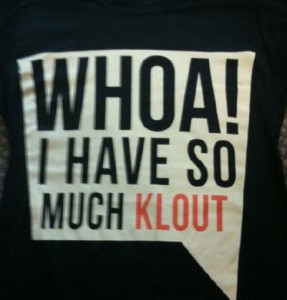
KloutOne of those first tools out of the gate that so many in the social media world have been chattering about lately is Klout. Klout started out as a tool that measured a person’s influence based on Twitter only, which caused a bit of a stir from those who rightly thought that influence should not be determined by tweets alone. So, they added Facebook and, most recently, LinkedIn to the mix of profiles that help calculate a person’s Klout score. They also added the ability for others to give you Klout (or +K) in a certain topic – which is certainly a step in the right direction in terms of how influential others think you are. Klout is now starting to emerge as the tool for measuring social influence.

Well, almost.

When we think of social media, straight away we think of Twitter, Facebook and LinkedIn, right? But when we talk about social media influence (or, better yet, social influence), we’re talking about an animal of different stripes. Social influence isn’t just gauged by the “Big 3” social networking sites, it’s gauged by your entire social sphere and how your network is engaging with you. Influence in a certain topic shouldn’t necessarily be determined by how often you tweet about that topic, either (case in point – Klout has determined that our own Mitch Arnowitz is influential about ice cream and I’m influential about cars) – it should take into consideration other sources of content you’ve posted about the topic.

In terms of how they should be measuring influence, here’s what I hope to see from Klout in the near future:

Blogs

  • Ability to add your blog to your Klout profile to help determine score and influence in certain topics based on readers’ level of engagement with your blog (i.e. shares of posts, comments, Facebook Likes).
  • Ability for your blog readers to +K your blog posts for certain topics (imagine a +K button you can add to your blog).
  • Consideration of the comments you leave on other blogs (determined by services like Disqus).

LinkedIn

  • Consideration of posts in LinkedIn groups and how many people Like or comment on those posts.
  • Consideration of Answers you’ve provided on LinkedIn and how many were chosen as “Best” to determine topic influence.
  • Ability for companies to add their company pages.

Facebook

  • Ability for companies to add their Facebook pages.

Other social networks

  • Ability to add your Quora profile so Klout can analyze your answers to questions to help determine topic influence.
  • Ability to add your profiles from location-based services like Foursquare or Gowalla to factor in friends, tips (and how many people have “done” the things your tips mention), mayorships, badges. This might help to determine local influence. Update July 14: Klout has added Foursquare as one of the services affecting scores. No details on what kind of activity affects it (natch), but apparently they’re still trying to figure that out.

How do you think Klout should measure social influence and what should they be taking into consideration?

Filed Under: Influence, Social Media, Tools Tagged With: klout, social influence

  • « Previous Page
  • Page 1
  • …
  • Page 7
  • Page 8
  • Page 9
  • Page 10
  • Page 11
  • …
  • Page 21
  • Next Page »

Primary Sidebar

Menu of Services

  • Attendee Marketing
  • Speaker Acquisition
  • Advocacy Campaigns
  • Influencer Marketing
  • Social Media Outreach

Categories

Monthly Archive

Copyright © 2026 · Genesis Sample on Genesis Framework · WordPress · Log in